Publications
Complete list of my research papers, journal articles, and conference proceedings.
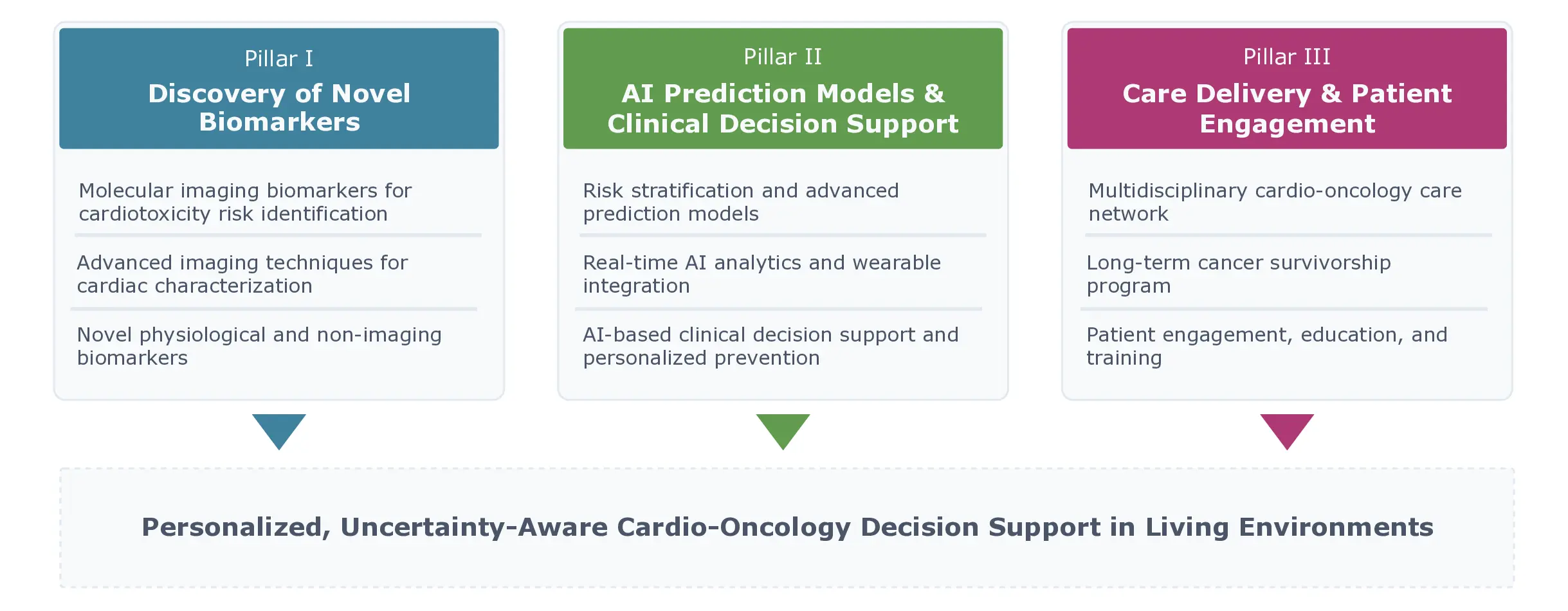
Wearable Monitoring for Early Cardiotoxicity Detection in Cancer Patients: The COMPASS Vision
Cancer therapies have substantially improved survival outcomes, yet cancer therapy-related cardiovascular toxicity (CTR-CVT) remains a major concern, with approximately one in four anticancer drugs carrying cardiac or vascular safety warnings. Since current monitoring relies on periodic hospital-based assessments, transient or progressively evolving cardiovascular alterations often escape timely detection. Within the context of COMPASS (Cardio-Oncology Multidisciplinary Patient Assistance Solution), an EU Innovative Health Initiative (IHI) project (Grant Agreement No. 101253264), this extended abstract explores continuous wearable sensing in real-world environments as a complementary paradigm for early detection of CTR-CVT. After reviewing the clinical indicators most relevant to longitudinal monitoring, we survey the corresponding wearable modalities together with their typical accuracy ranges and metrological limitations, and introduce the COMPASS research vision integrating wearable-derived data into AI-based clinical decision support for personalized cardio-oncology care.
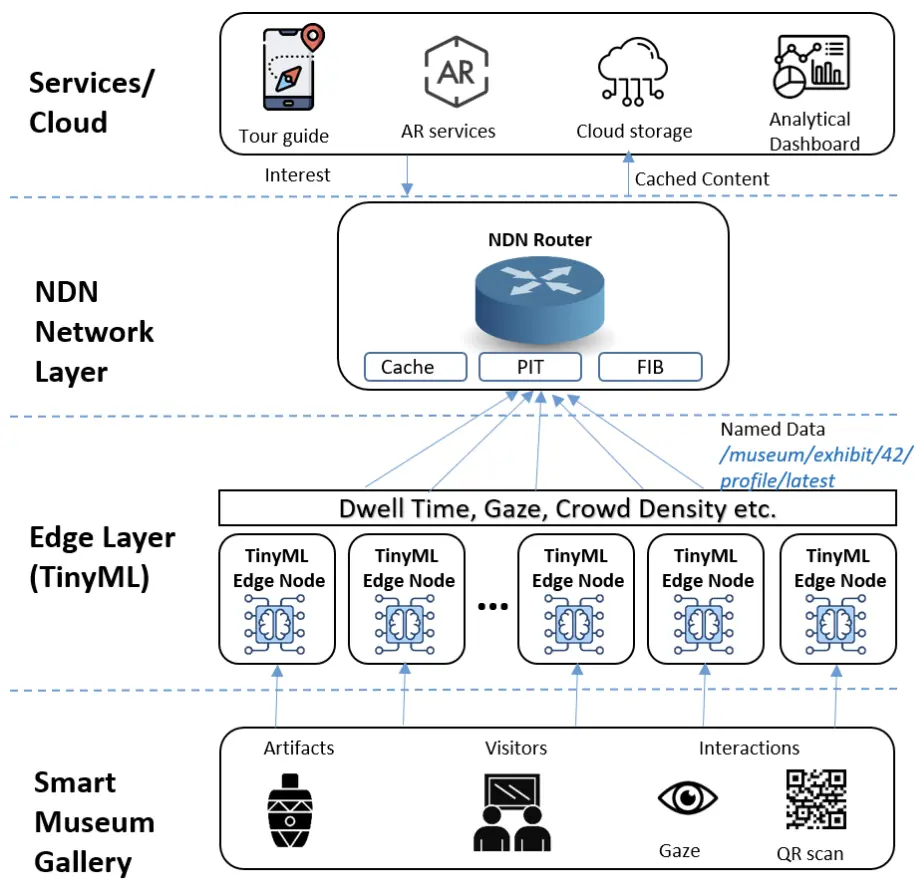
Named Data Networking (NDN) for Collective Network Intelligence: a Smart Museum case study
Future smart systems are increasingly characterized by pervasive AI deployed both at the back- and front-end. However, limiting intelligence to the software layer is insufficient to meet the scalability, adaptability, and resilience requirements of emerging large-scale cyber-physical ecosystems. Indeed, intelligence must extend across both the entire architectural stack and the infrastructure, including the network layer itself. In this paper, we explore Named Data Networking (NDN) as an enabler of collective intelligence at the network level. Unlike traditional IP-based architectures, NDN natively supports in-network caching, name-based routing, and stateful forwarding, thus enabling distributed decision-making mechanisms to emerge directly from the network fabric. We argue that these properties can be interpreted as forms of collective intelligence, where the network collaboratively optimizes content dissemination and resource utilization, and validate our findings through a Smart Museum case study.
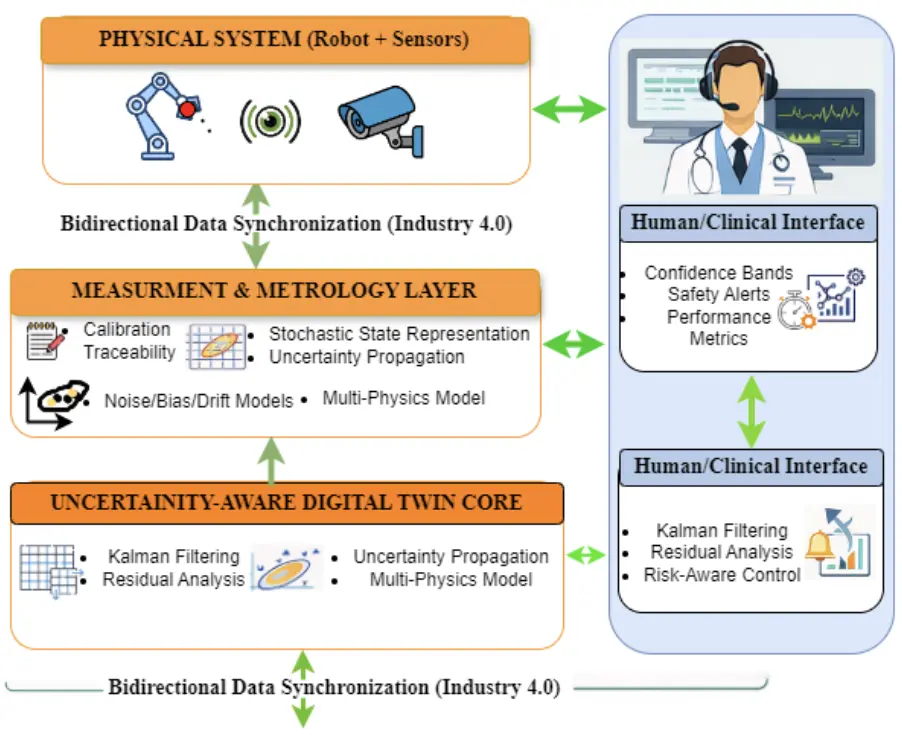
Uncertainty-Aware Digital Twins for Industry 4.0: A Metrology-Driven Conceptual Framework with a Healthcare Robotics Case Study
Digital twins have emerged as a key enabling technology in Industry 4.0, enabling virtual representations of physical systems that evolve in real time through data synchronization. They are widely applied to industrial robotic systems such as manipulators, collaborative robots, and automated production cells for applications including process monitoring, predictive maintenance, and control optimization. Despite their growing adoption, many existing digital twin implementations implicitly assume that sensor measurements are accurate and reliable. In practice, measurements of key variables such as position, velocity, force, and system states are affected by uncertainty arising from noise, bias, drift, and environmental disturbances, which can significantly impact the reliability of digital twin predictions. This paper proposes a metrology-driven conceptual framework for uncertainty-aware digital twins (UA-DTs), integrating measurement uncertainty into the digital twin lifecycle to ensure trustworthy monitoring and control, exemplified through a healthcare robotics case study.
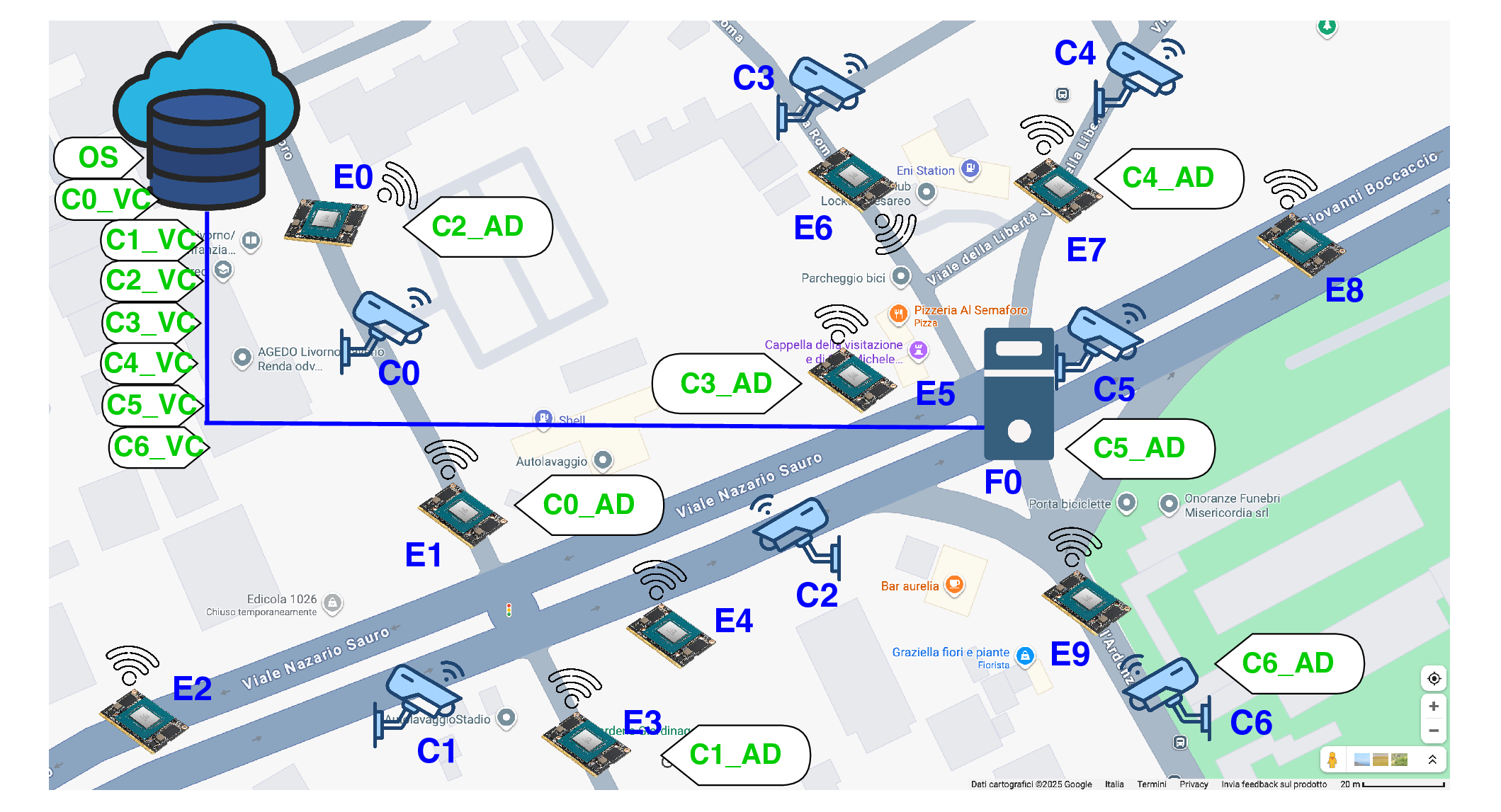
Enhancing Intelligent Transportation Systems with Optimal Cloud-to-Things Resource Allocation
Urban sensing for Intelligent Transportation Systems (ITS) increasingly relies on the Cloud-to-Things Continuum (C2TC), to balance latency, reliability, and computational demand. Systems based solely on cloud platforms can no longer guarantee these requirements, especially as the number of sensors and monitoring devices continues to grow, increasing the overall data exchange. By deploying edge Artificial Intelligence (edge-AI) models for vehicle detection and counting at the network edge, intersections can adapt signal plans locally, reducing reaction times and data traffic. In this paper, we tackle the problem of optimal task placement in the C2TC to meet the temporal requirements of edge-AI–based ITS. We propose a workflow that integrates J-NECORA, an analytical framework that computes optimal resource allocation under Quality of Service (QoS) constraints, with the EdgeCloudSim simulator, to assess additional Key performance indicators (KPIs) such as network time, node utilization and missed deadlines. The workflow is evaluated in an urban traffic scenario, and results show that it provides deeper and broader insights compared to a purely analytical approach, confirming the effectiveness of the proposed approach for designing time-critical, edge-enabled ITS.
Engineering Opportunistic Digital Twins with Lingua Franca
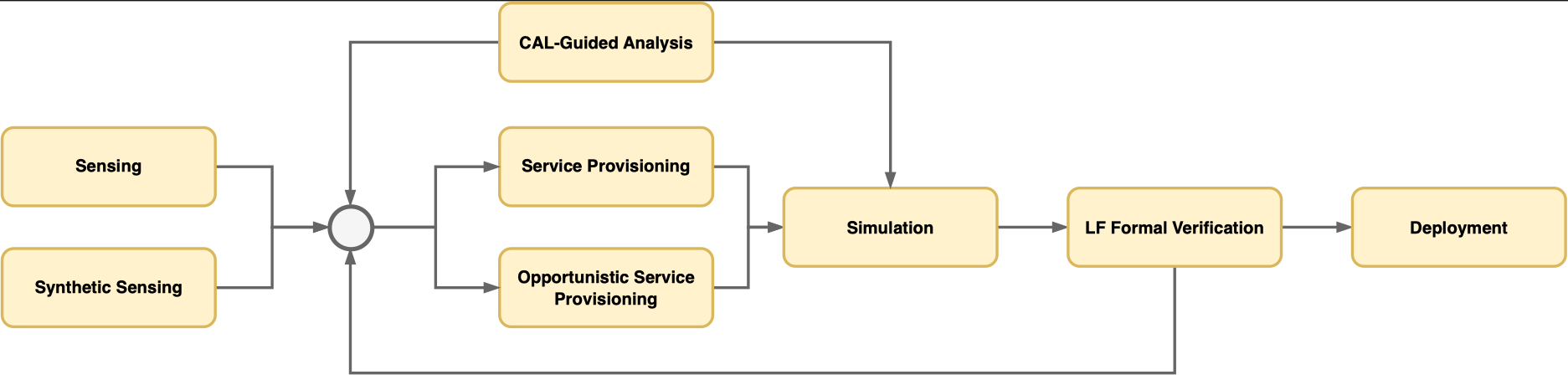
Digital Twins (DTs) have emerged as essential tools for virtualizing and enhancing Cyber-Physical Systems (CPS) by providing synchronized digital counterparts that enable monitoring, control, prediction, and optimization. Initially conceived as passive digital shadows, DTs are increasingly evolving into intelligent and proactive entities, enabled by the integration of Artificial Intelligence (AI). Among these advancements, Opportunistic Digital Twins (ODTs) represent a novel class of DTs: living, AI-aided, and actionable models that opportunistically exploit edge-cloud resources to deliver enriched and adaptive representations of physical entities and processes. However, despite their promise, current research lacks systematic engineering methods to ensure reliable coordination, determinism, and real-time responsiveness of ODTs in distributed and resource-constrained CPS. This article addresses this gap by introducing an engineering approach to build dependable and efficient ODTs by leveraging the deterministic concurrency, explicit timing semantics, and disciplined event handling of Lingua Franca (LF). The approach is exemplified through a Smart Traffic Management case study centered on Emergency Vehicle Preemption (EVP), where the ODT dynamically selects AI models based on runtime conditions while ensuring deterministic coordination across distributed nodes. Experimental results confirm the feasibility and effectiveness of our methodology, underscoring the potential of LF-based ODT engineering to enhance reliability, adaptability, and scalability in intelligent and distributed CPS deployments.